Hydroponics: 90% Less Water Than Conventional Farming
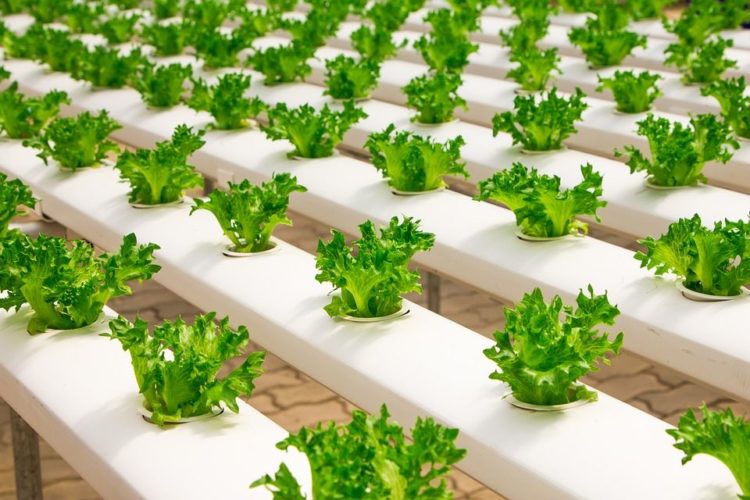
Plants need water. They do not need soil.

That simple fact has led to a very different way of growing food.

It is called hydroponics.

In a hydroponic system, plant roots get water and nutrients directly. Many systems collect the water the plants do not use and send it around again.

This can save an astonishing amount of water.

In one detailed comparison of lettuce production in Arizona, researchers estimated that hydroponic lettuce used about 20 liters of water to produce one kilogram of lettuce. Conventional lettuce used about 250 liters.1

That is about 92% less water per kilogram of lettuce.

But hydroponics also has costs. The same study found that its hydroponic system used far more energy.1

So is hydroponics really a better way to grow food?

Let’s look at the evidence.

What Is Hydroponics?

Plants normally grow with their roots in soil. But the soil itself is not food.

Plants need water, light, carbon dioxide, oxygen, and mineral nutrients such as nitrogen, phosphorus, potassium, calcium, and magnesium.

Soil is one way to deliver water and nutrients to roots. Hydroponics is another.

In hydroponics, the roots are placed in nutrient-rich water or in a material that holds the roots while nutrient-rich water flows past them.2

Some systems let the water pass through once. Better water-saving systems collect it, check it, and use it again.2

This is called a closed or recirculating system.

“Hydroponic cultivation is an efficient, resource-saving technology that produces high yields of high-quality products per unit area without soil.”

— SHUYAO WANG AND COLLEAGUES
Reviews in Environmental Science and Bio/Technology
https://doi.org/10.1007/s11157-024-09699-y

How Can Growing Plants in Water Use Less Water?

It sounds backwards.

How can growing plants in water use less water than growing them in soil?

The answer is reuse.

When a field is watered, not all of that water ends up inside the crop. Some can evaporate. Some can move below the roots. Some can run away from the field.

A closed hydroponic system works differently.

Water flows past the roots. The plant takes what it needs. Much of the water that remains is collected and sent back through the system.

The Food and Agriculture Organization of the United Nations says hydroponics generally needs less water because very little water leaves the system as return flow.3

The result can be a huge increase in the amount of food grown from each liter of water.

Diagram showing how a closed hydroponic system pumps water to plant roots, collects unused water, and uses it again

Can Hydroponics Really Use 90% Less Water?

Yes, it can.

But 90% is not a rule for every crop, farm, climate, or hydroponic system.

One of the clearest comparisons looked at lettuce production in Arizona.

The researchers estimated that conventional lettuce farming used about 250 liters of water for every kilogram of lettuce produced. Hydroponic lettuce used about 20 liters.1

That works out to about 92% less water per kilogram of food.

The same study found another major difference.

The hydroponic system produced about 41 kilograms of lettuce per square meter each year. Conventional farming produced about 3.9 kilograms.1

That was roughly 11 times as much lettuce from the same amount of land.

Comparison of hydroponic and conventional lettuce farming showing estimated water use and lettuce production per square meter

“Hydroponics offered 11 ± 1.7 times higher yields but required 82 ± 11 times more energy.”

— GUILLAUME BARBOSA AND COLLEAGUES
International Journal of Environmental Research and Public Health
https://pubmed.ncbi.nlm.nih.gov/26086708/

That last part is important.

Hydroponics saved enormous amounts of water and land in this comparison. But it used much more energy.

There is no free lunch.

Why Can Hydroponics Grow So Much Food in So Little Space?

A field has one growing surface: the ground.

Hydroponic farms can use space differently.

Plants can be placed closer together when their water and nutrients are carefully controlled. Crops can also be grown on shelves, towers, or vertical columns.

That means one square meter of floor can hold several square meters of growing space.

A controlled experiment with lettuce compared vertical hydroponic columns with a normal horizontal hydroponic system. The vertical system produced more lettuce for each square meter of floor space.4

This is one reason hydroponics is interesting for cities.

A farm no longer needs a huge flat field. Food can be grown in greenhouses, warehouses, rooftops, and other places where ordinary farming would be difficult.

Hydroponics Can Grow Food Where Good Soil Is Scarce

Hydroponics does not depend on fertile soil.

That matters in places with poor soil, little farmland, or very dry conditions.

It can also allow crops to be grown closer to the people who will eat them.

The Food and Agriculture Organization says hydroponics can be especially useful where good soil or farmable land is limited. When it is combined with protected growing systems, crops can also be produced throughout the year.5

NASA has studied hydroponics for an even more extreme reason.

Spacecraft do not have fields.

For decades, NASA researchers have studied ways to grow food with very little soil, water, and space. Their work has included recirculating hydroponic systems and vertical growing chambers.6

A system that can save water on Earth becomes even more valuable when every kilogram of water has to travel into space.

Can Hydroponics Grow Food Without Pesticides?

Not automatically.

This is one claim in the old version of this article that needed to be corrected.

Growing indoors can make it easier to keep some insects away. But hydroponic plants can still get pests and diseases.

In fact, shared water can create a special problem.

If a disease-causing organism gets into a recirculating system, the moving water can carry it from one plant to another.2

Researchers have found that fungi and fungus-like organisms such as Pythium, Phytophthora, Fusarium, and Verticillium can spread through hydroponic nutrient solutions.2

Good hydroponic farming therefore requires careful cleaning, monitoring, and disease control.

Hydroponics can reduce some pest problems. It does not make them disappear.

Plants Can Also Change the Water

There is another problem with using the same water again and again.

Roots do not only take things from water. They also release substances into it.

Over time, some of these root chemicals can build up in a closed system. At high enough levels, some can slow plant growth.2

Growers therefore have to watch the nutrient solution carefully.

They may need to filter it, disinfect it, adjust its nutrients, or replace some of it.

Saving water is possible because the water is reused. But reusing water also means that whatever gets into that water can be reused too.

The Biggest Problem: Energy

Hydroponics and indoor farming are often described as environmentally friendly.

That can be true in some ways. But it depends heavily on how the farm is built and where its energy comes from.

The hydroponics trade-off showing lower water use, greater lettuce production per square meter, and higher energy use

Pumps need electricity.

Indoor farms may also need lights, fans, heating, cooling, and equipment to control humidity.

Those needs can be enormous.

In the Arizona lettuce comparison, hydroponics used about 82 times more energy per kilogram of lettuce than conventional production.1

Most of that energy went to heating and cooling. Artificial lighting was another large use.1

Newer research still identifies energy use as one of the biggest challenges facing controlled-environment farming.7,8

This does not mean all hydroponics uses huge amounts of energy.

A simple outdoor or sunlit greenhouse system is very different from a windowless vertical farm filled with electric lights.

That distinction matters.

Is Hydroponics Better for the Environment?

There is no single answer.

Hydroponics can use far less water and land. It can also recycle nutrients and grow food in places where good farmland is scarce.

But some systems require large amounts of electricity and expensive equipment. Poorly managed systems can also release nutrient-rich wastewater or spread disease through recirculating water.2

A 2025 life-cycle study of lettuce found this same trade-off. Controlled hydroponic farming used less irrigation water and had lower impacts in several environmental categories, but its high energy use created a larger climate impact than open-field and low-energy greenhouse production in the systems studied.9

So asking whether “hydroponics” is sustainable is too broad.

We need to ask what kind of hydroponic system we are talking about.

Does it use sunlight or electric lights? Does it recycle its water? Where does its electricity come from? What crop is being grown?

Those details can completely change the answer.

What Hydroponics Does Best

Hydroponics is especially well suited to crops that grow quickly and have high value for their size.

Lettuce, herbs, leafy greens, strawberries, cucumbers, peppers, and tomatoes are common examples.

It makes much less sense to assume that every crop should move indoors.

Growing huge amounts of wheat, corn, or other low-value field crops under electric lights would require enormous amounts of space and energy.

Hydroponics is unlikely to replace all farming. It makes more sense to use it for the crops and places where its advantages matter most.

A Different Way to Think About Farming

For thousands of years, farming has meant planting crops in the ground and bringing water to them.

Hydroponics changes that idea. We bring the roots directly to nutrient-rich water, then collect much of that water and use it again.

In one major lettuce comparison, researchers estimated that hydroponics used about 92% less water per kilogram of lettuce and produced about 11 times more lettuce per square meter each year.1

Those numbers do not apply to every hydroponic farm.

But they prove something important.

We can grow food using far less water and far less land than conventional farming sometimes requires.

The challenge now is to do it without replacing a water problem with an energy problem.

That is where the real future of hydroponics lies.

References

  1. Barbosa GL, Gadelha FDA, Kublik N, et al. Comparison of land, water, and energy requirements of lettuce grown using hydroponic vs. conventional agricultural methods. International Journal of Environmental Research and Public Health. 2015;12(6):6879–6891. doi:10.3390/ijerph120606879. PubMed.
  2. Wang S, Kleiner Y, Clark SM, Raghavan V, Tartakovsky B. Review of current hydroponic food production practices and the potential role of bioelectrochemical systems. Reviews in Environmental Science and Bio/Technology. 2024;23:897–921. doi:10.1007/s11157-024-09699-y. Study.
  3. Food and Agriculture Organization of the United Nations. Guidance on Realizing Real Water Savings with Crop Water Productivity Interventions. FAO; 2021. FAO.
  4. Touliatos D, Dodd IC, McAinsh M. Vertical farming increases lettuce yield per unit area compared to conventional horizontal hydroponics. Food and Energy Security. 2016;5(3):184–191. doi:10.1002/fes3.83. PubMed.
  5. Food and Agriculture Organization of the United Nations. Growing without soil: hydroponics fundamentals, pros and cons. FAO Plant Production and Protection. 2024. FAO.
  6. National Aeronautics and Space Administration. NASA’s Contributions to Controlled Environment Agriculture. NASA Technical Reports Server. 2016. NASA.
  7. Al-Kodmany K. Review of energy efficiency in controlled environment agriculture. Renewable and Sustainable Energy Reviews. 2021;141:110786. doi:10.1016/j.rser.2021.110786. Study.
  8. Aghajanzadeh A, Carleton B, Negron-Juarez R, Smith D, Schmick R, Stokes-Draut J. Technology pathways for energy- and water-efficient controlled environment agriculture: A review of technologies, implementation pathways, and regional use cases. Sustainable Energy Technologies and Assessments. 2026;91:105136. doi:10.1016/j.seta.2026.105136. Study.
  9. The challenges of controlled environment hydroponic farming: a life cycle assessment of lettuce. International Journal of Life Cycle Assessment. 2025. doi:10.1007/s11367-025-02463-6. Study.